
* coming soon *
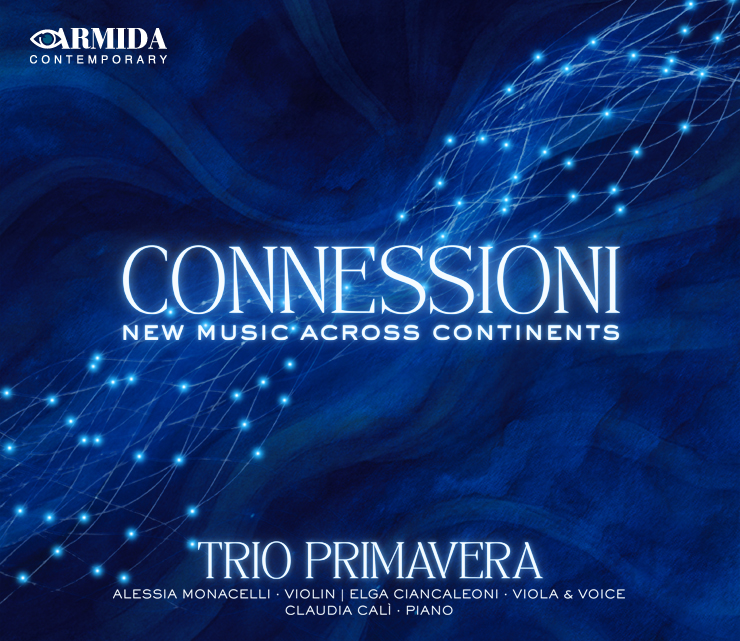
Armida Records 11-000000
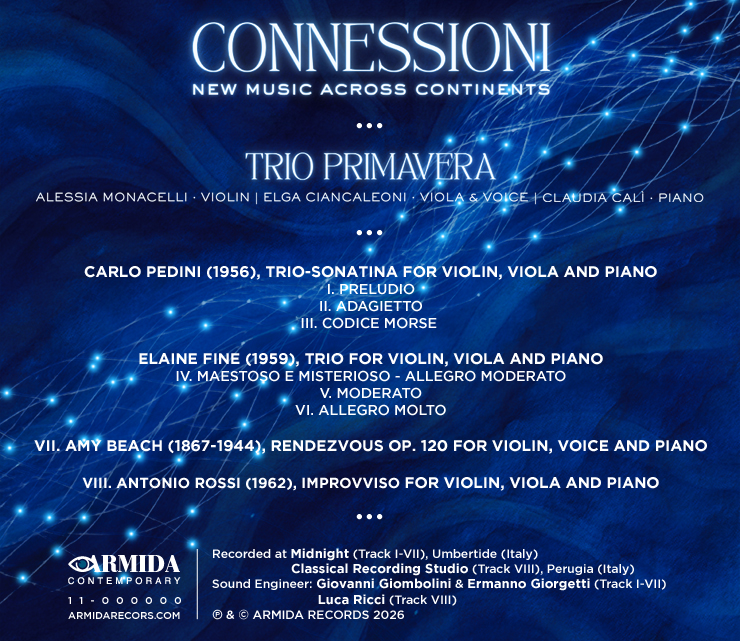
artist: TRIO PRIMAVERA
CONNESSIONI – NEW MUSIC ACROSS CONTINENTS

Carlo Pedini (1956), Trio-Sonatina for violin, viola and piano
I. Preludio
II. Adagietto
III. Codice Morse
Elaine Fine (1959), Trio for violin, viola and piano
IV. Maestoso e Misterioso – Allegro Moderato
V. Moderato
VI. Allegro Molto
VII. Amy Beach (1867-1944), Rendezvous Op. 120 for violin, voice and piano
VIII. Antonio Rossi (1962), Improvviso for violin, viola and piano
Carlo Pedini (1956), Trio-Sonatina for violin, viola and piano
Trio Sonatina, composed in 2023 by Carlo Pedini and conceived specifically for Trio Primavera, is structured in three movements according to a traditional Sonata-form design. The work comprises an introductory Preludio, a central Adagietto, and a third movement of distinctly rhythmic and energetic character entitled Codice Morse (Morse Code). The Preludio, marked Allegro, unfolds through the alternation of two contrasting themes. The first, lyrical in nature, is introduced by the violin and viola, which exchange the melodic line in a dynamic and refined dialogue. The second theme, entrusted to the piano, draws inspiration from the harmonic structure of Chopin’s Prelude in C minor, yet is reinterpreted through an irregular 7/8 rhythmic language that lends the piece an original and pulsating character. The second movement, Adagietto – whose title clearly alludes to Mahler’s Fifth Symphony – revisits thematic material from the Preludio, reworking it into a rarefied sonic texture that evokes a suspended, at times almost enchanted atmosphere. Its form is divided into two distinct sections. The first, chorale-like in character, features the gradual entrance of the instruments – piano, viola, and finally violin – which progressively overlap, intensifying the timbral color and deepening the harmonic fabric. In the second section, the pizzicato of the violin and viola enters into dialogue – both contrasting and blending – with the piano’s long descending scales, creating an evocative sound effect reminiscent of drops of water or luminous tears falling slowly, and generating a poetic, almost transcendent dimension. The third movement, which revisits and reworks thematic and harmonic elements introduced in the first two movements, is built upon a rhythmic structure directly inspired by the intermittent, pulsating patterns of Morse code, from which it takes its title. This rhythmic element permeates the musical texture, giving the movement a sharp momentum and expressive vitality that culminate in an intense and emotionally charged final crescendo.
Elaine Fine (1959), Trio for violin, viola and piano
Elaine Fine is an American composer and violist, who has written works in a wide range of genres, some released into the public domain to support performers, and others published by the International Music Company of New York. Over the years, she has received several awards from the American Society of Composers, Authors and Publishers (ASCAP). Also highly active as a music educator and as a promoter of significant social initiatives for musicians, she has composed more than 200 works, including chamber music, operas, and arrangements. Her Trio for Violin, Viola, and Piano, composed in 2012, opens pianissimo with a subtly mysterious atmosphere, before moving in the first movement toward a more dance-like character. The second movement is inspired by Christopher Simpson’s The Division Viol (1655) and is therefore imbued with Baroque echoes. The third movement, bright and rhythmic, is built on a driving, recurring motif that the three instruments exchange among themselves.
Amy Beach (1867-1944), Rendezvous Op. 120 for violin, voice and piano
Rendezvous is a lyrical and intimate work that exemplifies Beach’s gift for melody and harmonic color, showcasing her ability to explore intimate chamber combinations while refining her distinctively lyrical style. The unusual scoring for violin, voice, and piano reflects Beach’s interest in blending vocal and instrumental lyricism, creating a rich dialogue among the three voices that allows for expressive interplay between text, melody, and accompaniment.
The text, with its deeply musical verse, proved an ideal match for Beach’s lyrical sensibility. Written by Lady Leonora Speyer – a Pulitzer Prize-winning poet and former concert violinist – the poem adds a poignant dimension to this work, resonating with particular significance in a piece scored for violin, voice, and piano. Throughout the work, the voice and violin serve as equal melodic partners, intertwining and exchanging thematic material, while the piano provides a supportive yet harmonically rich foundation. The text speaks of a tender meeting – a “rendezvous” – evoking themes of longing, anticipation, and emotional intimacy. Beach’s setting captures both the delicacy and emotional depth of the poetry through sweeping melodic lines, subtle chromaticism, and moments of expressive tension and release. The work reflects Beach’s Romantic sensibility while incorporating the more modern harmonic nuances characteristic of her later output, blending nostalgia with a refined and personal voice.
Antonio Rossi (1962), Improvviso for violin, viola and piano
The Improvviso that composer Antonio Rossi conceived expressly for Trio Primavera is formally built upon two contrasting themes marked by expansive melodic lines. Though conceived within a tonal framework, the work features enharmonic and chromatic passages that create evocative moments of tension, yielding to passages where all dissolves into a kind of melodic serenity. The violin and viola engage in unexpected counterpoint throughout, while the piano – through its near-ostinato accompaniment – not only shapes the harmony but also asserts a distinctive and prominent identity. The compositional vision pursues poetic lyricism through profound introspection.
+ + +
Recorded at Midnight (Track I-VII), Umbertide (Italy) | Classical Recording Studio (Track VIII), Perugia (Italy)
Sound Engineer: Giovanni Giombolini & Ermanno Giorgetti (Track I-VII) Luca Ricci (Track VIII)