
Armida Records 11-201226
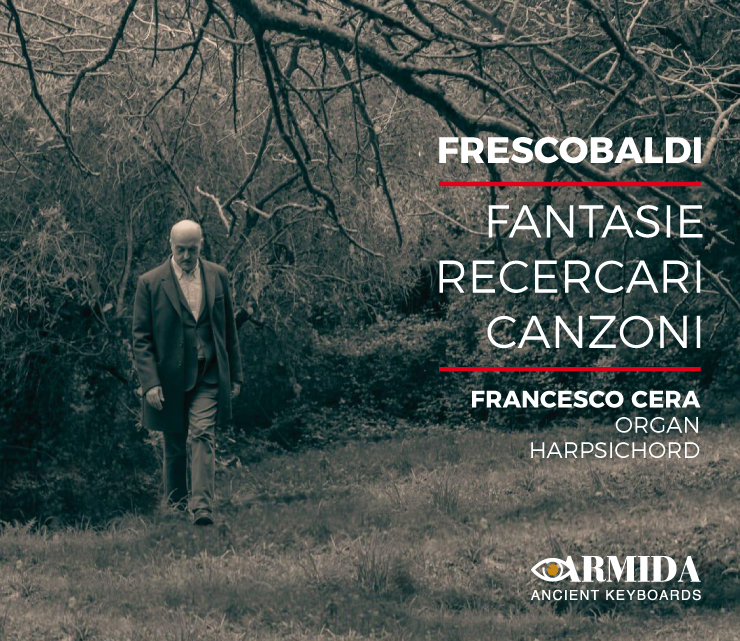
artist: FRANCESCO CERA organ harpsichord
GIROLAMO FRESCOBALDI (1583 – 1643)
Fantasie Recercari Canzoni

CD 1
01 • Fantasia prima sopra un soggetto
02 • Fantasia ottava sopra tre soggetti
03 • Fantasia quarta sopra due soggetti
04 • Fantasia seconda sopra un soggetto
05 • Fantasia terza sopra due soggetti
06 • Fantasia settima sopra tre soggetti
07 • Fantasia quinta sopra due soggetti
08 • Fantasia nona sopra tre soggetti
09 • Fantasia duodecima sopra quattro soggetti
10 • Fantasia undecima sopra quattro soggetti
11 • Fantasia sesta sopra due soggetti
12 • Fantasia decima sopra quattro soggetti
• • • • •
CD 2
01 • Canzon prima
02 • Recercar primo
03 • Canzon seconda
04 • Recercar secondo
05 • Recercar settimo sopra sol mi fa la sol
06 • Canzon terza
07 • Recercar terzo
08 • Canzon quinta
09 • Recercar quarto sopra mi re fa mi
10 • Recercar ottavo obbligo di non uscir mai di grado
11 • Canzon quarta
12 • Recercar nono con quattro soggetti
13 • Recercar quinto
14 • Recercar sesto sopra fa fa sol la fa
15 • Recercar decimo sopra la fa sol la re
GIROLAMO FRESCOBALDI
FANTASIE RECERCARI CANZONI
It is fair to say that Girolamo Frescobaldi, despite playing a pivotal role as an innovator of European keyboard music, is at once the first master of the Baroque and the last master of the Renaissance. Much as his Toccate – composed in Rome and in the spirit of the nascent Baroque – are admired today, his first published keyboard work, the twelve Fantasie, remains unjustly neglected. Still Renaissance in style, these were printed in Milan in 1608, when the composer was only twenty-five. Even as refined musical products of their time, Frescobaldi’s Fantasie can offer today’s listener a surprising taste of modernity. These twelve keyboard Fantasie are extremely pure and rigorously essential works, despite the daring complexity of their compositional structure. The themes of the Fantasie possess nothing melodic or cantabile about them. They are, rather, perfect formulae constructed from notes in varying relationships to one another. The masterfully subtle intellectual and musical game by which a musical formula is gradually modified – a perfectly calibrated metamorphosis, as it were – reminds one of the unfolding of the modular and mobile structures created by Alexander Calder.
To listen to Frescobaldi’s Fantasie is to immerse oneself in a flowing stream of spellbinding sound, stepping into a web of infinite combinations between the themes (the soggetti mentioned in the titles) and their progressive transformations: by inverse motion, augmentation, diminution, and through the rare artifice of inganni. 1
Rather than looking back to the keyboard masters of the previous generation (Gabrieli, Merulo, Luzzaschi), the young Frescobaldi seems to have retraced the footsteps of those Flemish composers who, a century earlier, had brought their incredible audacity in the art of counterpoint to his native Ferrara. Frescobaldi, for his part, enriches this intellectual game with harmonic tensions, dissonances, and veritable, entirely novel chromatic ‘deformations’ – which would become so dear to him in his later years. Articulated across multiple sections, the process of continuous variation which the themes undergo unfolds through progressive degrees of speed, passing from serene meditation to the most frenetic velocities, incorporating lively rhythmic interplay – itself of clear Flemish heritage – and culminating in the solemn concluding sections.
The collection of Ricercari e Canzoni francesi was published in 1615 in Rome, where Frescobaldi had already lived and worked for several years as organist of St Peter’s Basilica and harpsichordist to Cardinal Aldobrandini, to whom the work is dedicated. The Ricercari reveal the extent to which Frescobaldi embraced the influence of the Roman polyphonic tradition – Giovanni Pierluigi da Palestrina, to name its foremost representative. Compared with the Fantasie, the softer treatment of dissonance and – above all – significantly more cantabile part-writing in these works foreshadow Frescobaldi’s mature style, particularly that of the Capricci (1624) and Fiori musicali (1635). Frescobaldi’s compositional ingenuity extends to treating the theme in the manner of an ‘ostinato’, entrusting it to a single voice (the alto in the Recercare sesto sopra fa fa sol la fa and the soprano in the Recercare decimo sopra la fa sol la re) or imposing upon himself the constraint of constant movement by leap in all four voices, as in the Recercare ottavo con obligo di non uscir mai di grado (‘with the obligation never to proceed by step’). The five Canzoni are distinguished by their lively part-writing and the rhythmic interplay which the themes progressively undergo throughout their development. They demand considerable finger dexterity from the performer.
With his Fantasie, together with the Ricercari e Canzoni francesi included on this recording, Frescobaldi offers a truly extraordinary corpus of contrapuntal keyboard music. It represents a crucial transition between the Renaissance counterpoint of Cabezón, Byrd, and Sweelinck, and Bach’s The Art of Fugue.
1 Through the device of inganno (‘deception’), the composer modifies the pitch of one or more notes of a subject by transposing them into one of the three hexachords. The names of the notes are preserved but not their actual pitch; the ear is thus deceived by the composer’s occasional transposition of them.
THE INSTRUMENTS
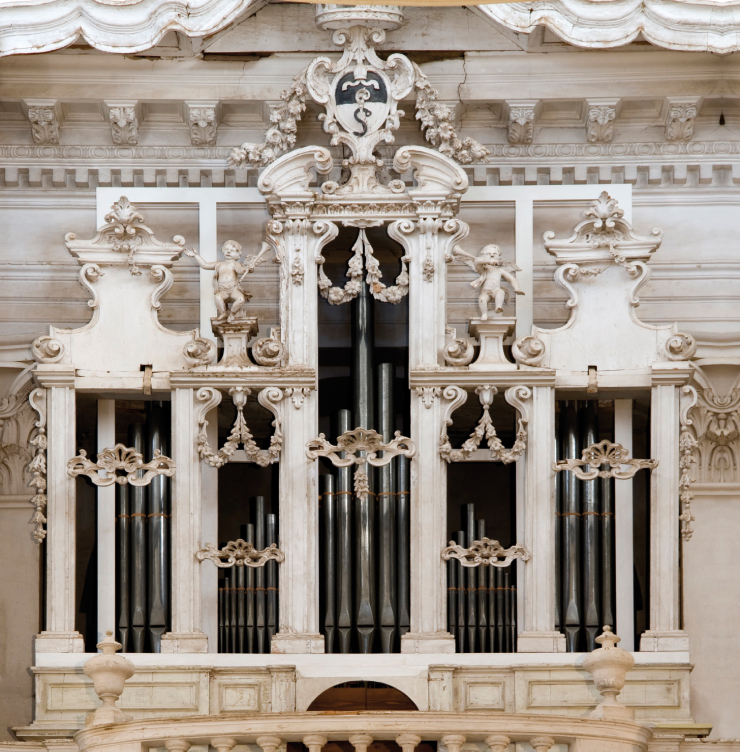
For this recording, I have chosen an exceptionally fine organ with exceedingly rare characteristics, recorded here for the very first time. Built between 1523 and 1538 by Giovanni Piffaro for the great church of Sant’Agostino in Siena, this imposing instrument features certain stops with double and triple ranks of unison pipes in the middle and upper range. This distinctive trait imparts an extraordinary luminosity to the sound and exceptional clarity to the complex polyphonic structure of this music. When the Principale and Ottava are drawn, the treble range features no fewer than six ranks of pipes. The ranks of the Ripieno are paired together in a truly unique manner, presenting the organist with very specific choices. The sole colour stop is the exquisite Flauto in ottava, constructed during the seventeenth century with stopped pipes in the bass and tapered pipes in the treble. The surprisingly high pitch of this organ – approximately a tone and a half higher than 440 Hz – is an historically documented feature in early Italian Renaissance organs.
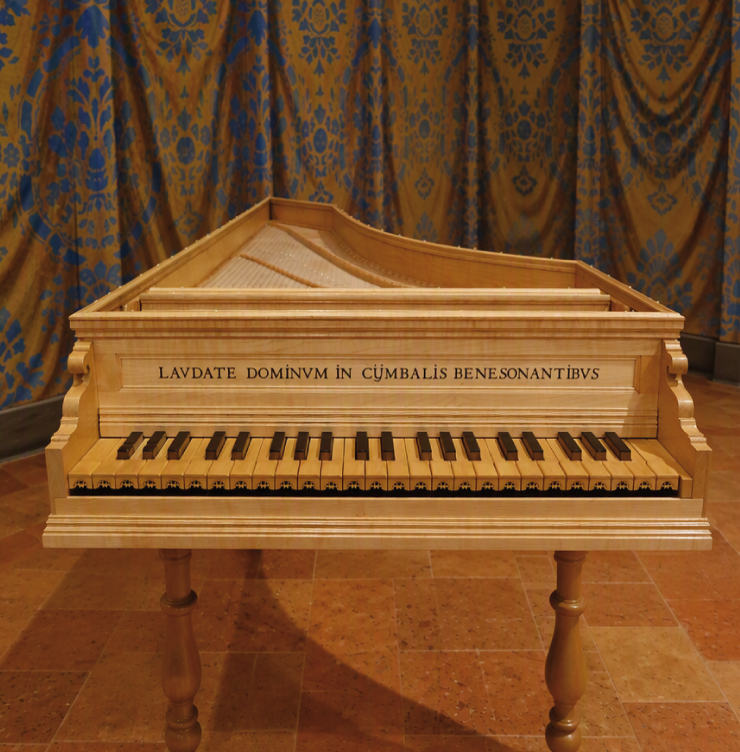
The two harpsichords, built by Roberto Livi, are copies of mid–sixteenth–century Italian instruments preserved at the Museum of Fine Arts in Boston and in the Beurmann Collection at the Museum für Kunst und Gewerbe in Hamburg. The first has a maple case and features two registers, one 8′ and one 4′, with a compass of C1–C5, short octave. The second instrument features a single 8′ register with a compass of C1–C5 (lacking C♯1) and a cypress wood case. Both instruments are quilled with seagull feathers, and tuned to the historical chamber pitch of 415 Hz using quarter-comma meantone temperament.
THE ORGAN OF THE CHURCH OF SANT’AGOSTINO, SIENA
The organ was built by Giovanni Piffaro between 1523 and 1538. Originally located on the left wall of the nave, it was moved to a choir loft on the counter-façade in 1755, following a fire that prompted the redecoration of the church to a design by Luigi Vanvitelli. The façade, built to a design by Giuseppe Silini, is currently positioned slightly forward relative to the instrument itself, in order to preserve the original structure given to it by Giovanni Piffaro. The restoration was carried out in 1987 by the workshop of Francesco Zanin, under the supervision of the organologist Oscar Mischiati.
Original walnut springchest with copper strips. The rollerboard and rollers are original.
The 54-note manual (by Ritterfels, 1793) has a compass of FF-c’’’, lacking FF♯ and GG♯.
The highest three keys (b♭’’-c’’’) are currently silent following the restoration of the original compass. The 13-note lectern pedalboard (1793) spans CC-E, with its actual compass beginning at FF, and is permanently coupled to the manual.
Six interlocking levers with vertical sliding action, located on the right of the keyboard, control the stops.
| Principale12′ (e-e♭ double, f-f’’ triple, f#’’-a’’double) Ottava (e-e♭’ double, f’-a’’ triple) XV + XXIX (15/29) XIX + XXXIII (19/33) XXII + XXVI (22/26) Flauto in ottava Tiratuttipedal (18th c.) | [1] * [6] [3] [5] [4] [2] |
Four wedge bellows operated by an electric blower. Wind pressure 45 mm.
The pitch (A = 523 Hz) was restored to its original level, approximately a tone and a half above 440 Hz, during the restoration.
* Order of stops on the windchest, starting from the façade
Texts by Francesco Cera (translated by Lothar Banse)
Testo in italiano
disponibile sul sito www.francescocera.it alla pagina Ancient Keyboards
ORGAN REGISTRATIONS
CD 1
Fantasia prima (track 1) Principale; + Ottava; – Principale + 15/29 22/26 (playing one octave lower, in 8’ range); + Principale and 19/33.
Fantasia ottava (track 2)Ottava; + 15/29; + 22/26 (playing in 8’ range); + Principale; + 19/33 (playing in 16’ range).
Fantasia quarta (track 3) Principale; Flauto in ottava; Principale Ottava.
Fantasia quinta (track 7) Principale Flauto in ottava.
Fantasia nona (track 8) Principale 19/33 Flauto in ottava; – Principale (playing in 8’ range).
Fantasia duodecima (track 9) Principale Ottava; – Principale + 15/29 19/33 22/26 (playing in 8’ range); + Principale (playing in 16’ range).
CD 2
Recercar settimo (track 5) Principale Ottava 15/19 19/33 22/26 (playing in 16’ range).
Canzon terza (track 6) Principale Flauto in ottava; + 22/26; Flauto in ottava; + Principale and 19/33.
Recercar terzo (track 7) Principale
Canzon quinta (track 8) Principale 15/29 Flauto in ottava; – Principale + 22/26 (playing in 8’ range)
Recercar quarto (track 9) Principale Ottava 15/19 19/33 22/26
Recercar sesto (track 14) Flauto in ottava 15/29 (playing in 8’ range)
Recercar decimo (track 15) Principale Ottava; + 19/33; + 15/29 22/26
“Light’s Shadow” by Marilena Abate
+ + +
Recorded at Perugia, Monastery of Sant’Agnese (February 2022) and Siena, Church of Sant’Agostino (November 2022)
Sound Engineer and Editing: Luca Ricci